Workflow and initial project scope
We document the trigger, participants, steps, exceptions and acceptance criteria, then prioritise a first usable version.
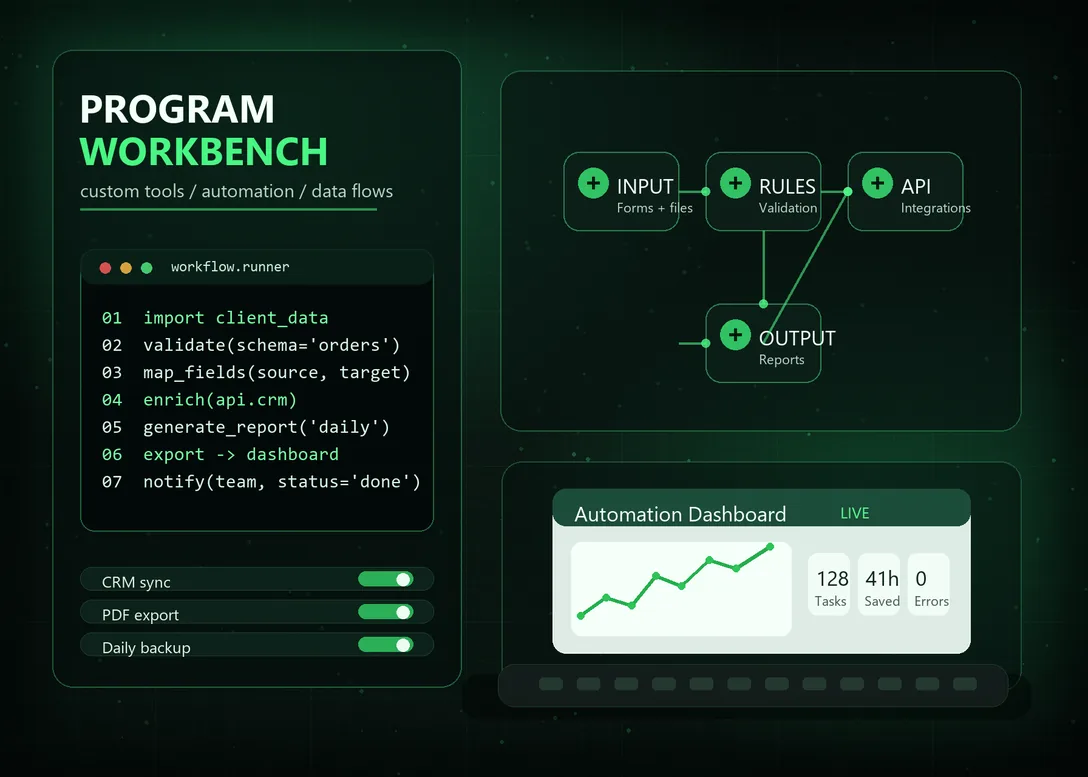
We develop solutions for a specific business workflow, from receiving a request through processing and approval to handing it over to the next system. Internal web tools, portals and dashboards connect your team's tasks with the data they need. Together, we define an initial scope that covers a useful, working process.
Personal collaboration from Dietikon for companies throughout Switzerland.
A request might arrive by email, be processed in Excel and then require approval from several people. Responsibility, missing information and the current version can become unclear. We map these handovers with your team, clarify exceptions and turn the process into a shared workspace with suitable connections to existing systems.
Status, ownership, documents and the next step are visible in context, rather than being pieced together from separate sources.
Forms, required information and approvals reflect the agreed steps. Open questions and exceptions remain identifiable.
Roles, views and dashboards follow the information and decisions staff need to carry out their work.
One prioritised workflow provides the foundation. Further features or departments are added based on experience from actual use.
We document the trigger, participants, steps, exceptions and acceptance criteria, then prioritise a first usable version.
Depending on the task, we build forms, overviews, approvals or protected areas for staff, customers or partners.
We review application programming interfaces (APIs), access permissions and data formats. Data flows and failure cases are defined before integration.
The data model, roles and access rules follow the workflow. We plan existing data imports and the handling of duplicate records.
We check common cases and exceptions using agreed examples. An introduction and suitable documentation help the team use the solution.
Before launch, we clarify responsibilities for hosting, updates, backups and maintenance. Additional features are agreed as further stages.
We divide the project into transparent stages. You see what is taking shape early and can make subject-matter decisions where they have the greatest impact.
Clarify goals, audiences, existing systems and success criteria together.
Prioritise content, user journeys, functions and technical architecture.
Develop and test in stages with visible intermediate results for review.
Launch cleanly, measure performance and expand for new requirements.
Software development is the technical implementation. Business solutions also cover the complete operational workflow: data capture, ownership, approvals, handovers and introduction to the team. This determines which features need custom development and which existing tools can be integrated.
Together, we select a bounded workflow with named users and clear acceptance criteria. Other requirements are prioritised. A first usable version helps determine the next steps based on concrete experience.
We review which systems are still needed and which interfaces or imports are available. Before any transfer, data mapping, access permissions and the handling of incorrect or duplicate entries are tested using sample data.
Workflow scope, user roles, data quality, integrations and operational requirements all matter. We clarify these before the quote and list agreed services for operation, maintenance or further development separately.
Describe the journey from the first entry to the finished outcome. We clarify the people involved, existing tools and a useful initial scope.